Independent project · 2021–Present
Mirri
Diabetes.
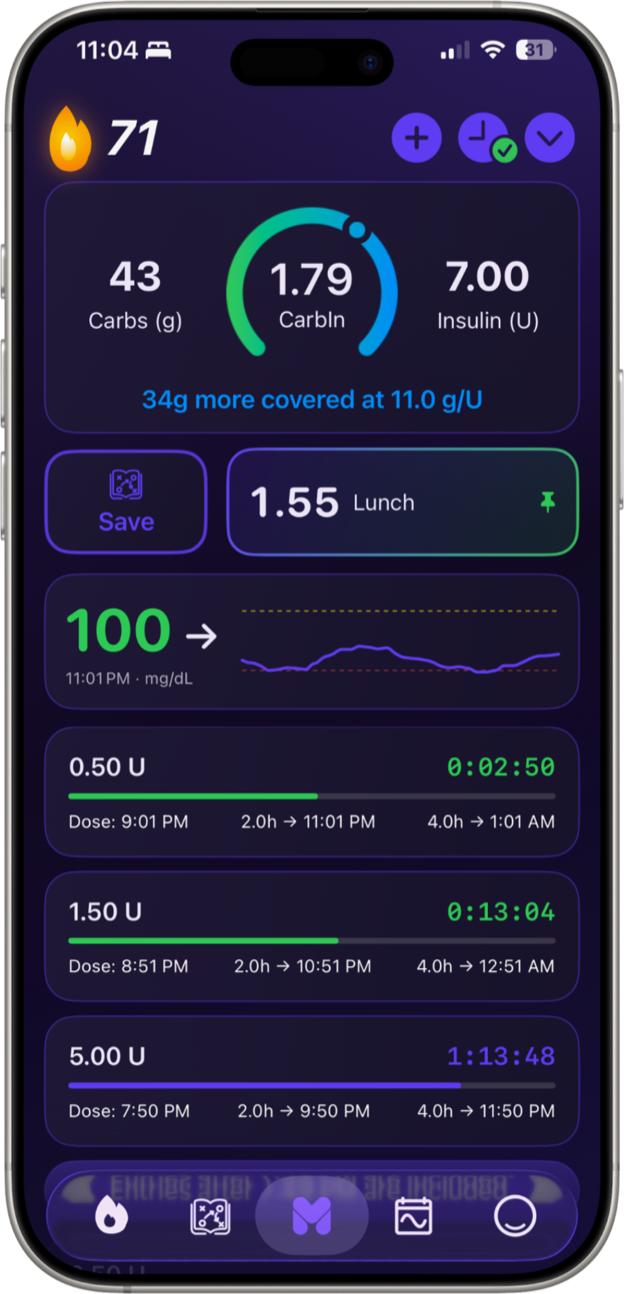
An Excel tool I built for my own Type 1 diabetes management grew into a multi-platform control and decision-support system.
The iteration
The model had to learn timing.
The first approach worked only when meals and insulin followed the expected schedule. When timing diverged, the model’s assumptions failed. That failure defined the next engineering problem.
- 01 / Problem
Manual decisions lacked context.
Meals, activity, insulin, and recent history lived in separate places.
- 02 / Early model
A simple control approach.
The first version connected inputs, a model, and a recommendation.
- 03 / Failure
Timing broke the assumptions.
Meal and insulin timing could diverge from the expected sequence.
- 04 / Improve
Represent the changing state.
The model evolved to account for more of the recent system history.
- 05 / Validate
Test before trusting.
Iterations were evaluated in UVA/Padova simulation and through structured user testing.
- 06 / Iterate
Carry evidence forward.
Results informed the controls, mobile experience, computation, and integrations.
One simplified view
From context to a useful recommendation.
The system combines recent context, processes it locally where possible, and presents a recommendation to the user. Device and data integrations reduce manual input while keeping the interface focused.
Validation references UVA/Padova simulation, not clinical outcomes.